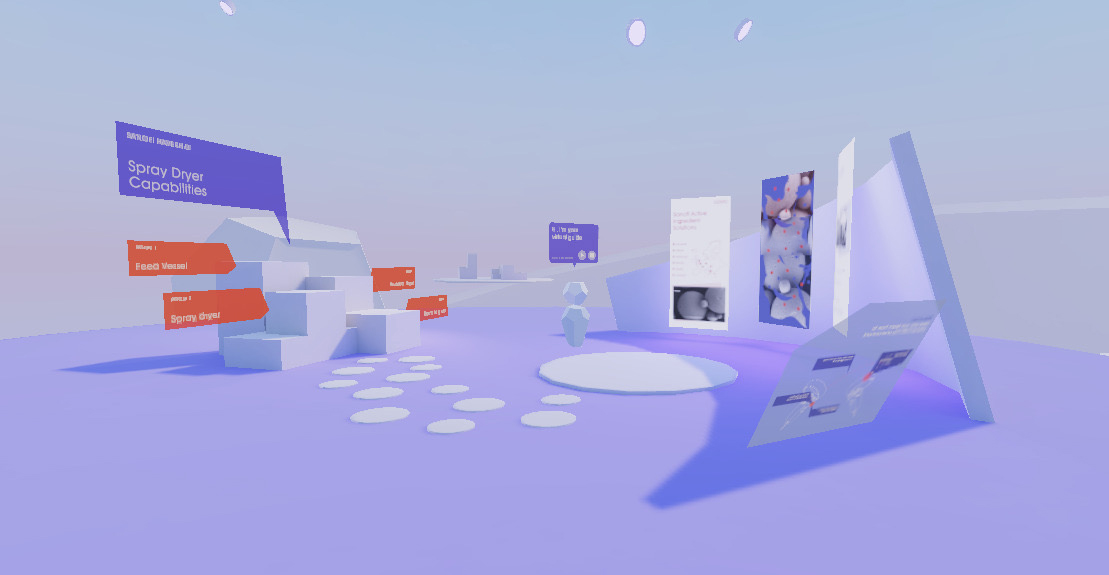
building vr for pharma manufacturing
date: July 27, 2020
Problem: A pharmaceutical company needed to show their production facility to potential customers at trade shows. The problem: customers couldn't visit actual clean rooms. Contamination risks made physical tours impossible. Existing virtual tours were flat 360° photos. No depth. No sense of scale. Limited ability to build the kind of trust that closes deals.
Solution: A fully immersive, multiplayer VR experience of their spray drying facility. Customers at trade shows could put on a headset and walk through the clean room, examine equipment, and understand the production process as if they were actually there.

What Made It Different
The real differentiator wasn't the VR itself. It was the multiplayer architecture. Sales representatives could join remotely using deterministic networking. A customer in Milan and a sales expert in another country could stand in the same virtual space, having real conversations while examining equipment together. The expert could point at a valve, explain the process, answer technical questions in context.
This changed the sales dynamic entirely. Instead of scheduling facility visits months in advance or relying on brochures, the company could provide expert-guided tours anywhere in the world, on demand.
Understanding the Customer
We started with a product vision workshop. The target audience was clear: pharma and biotech representatives at industry conferences. These were startup executives evaluating contract manufacturing partners and corporate teams (scientists plus procurement) validating equipment standards. They had limited time and specific questions about capabilities.
What did these customers actually need? Trust through facility transparency. Validation that quality standards were real. Evidence of technical innovation. And access to experts who could answer questions beyond what sales representatives typically handle.
The insight that shaped everything: these customers weren't looking for entertainment. They were looking for confidence. Confidence that this facility could manufacture their products safely, reliably, at scale. Every feature we built served that goal.
The experience needed to show the product journey through the spray drying process, allow free movement so users could explore at their own pace, provide equipment interactions that revealed technical details, maintain photorealistic representation of the actual clean room, support multi-user sessions with remote experts, and enable real-time voice communication.
Design Decisions
We chose photorealism over stylization. This wasn't an aesthetic preference. Trust required showing the actual facility. Customers needed to see the real clean room, the real equipment, the real conditions. We shot ultra high-res 360° photos and video on-site and built the VR environment around that photorealistic base.
Education over entertainment. Users needed to understand the production process, equipment capabilities, and quality standards. Every interaction revealed technical details. Tap on a valve, see its specifications. Walk through the process flow, understand how materials transform. The experience taught without feeling like a tutorial.
Multiplayer architecture was non-negotiable. The customer at a trade show booth and the expert at headquarters needed to tour together with real-time conversation. Deterministic networking kept both clients synchronized: when one user pointed at equipment, both saw the gesture. When one played an animated process visualization, both watched the same frames.
We built everything around a quality framework with three pillars. Innovation: demonstrating advanced spray drying technology. Expertise: providing expert access for process explanation. Excellence: showing safety and quality control standards. Each touchpoint in the VR experience reinforced at least one of these pillars.
Production Approach
We ran 12 weeks in four agile sprints. Sprint 1 established the basic environment and assets. Sprint 2 added detail work and captured the 360° content on-site. Sprint 3 focused on interactivity and user testing. Sprint 4 was final polish and intensive testing before the trade show deadline.
The on-site filming happened in a single day. One person, one DSLR rig, around 60 minutes per room. Five camera positions per room, multiple exposures per position for HDR and stitching. Clean room standards meant minimal approved equipment: DSLR rig, tablet for verification, power banks. No large crews. No multiple lighting setups.
The challenges were predictable but still demanding. Clean room contamination control meant only approved equipment could enter. Reflective metal surfaces created stitching problems where algorithms couldn't match reflections across frames. Lighting balance was difficult: bright overhead lights, dark corners, and metal reflections all in the same shot. And the limited time per room (60 minutes in full protective gear) meant no second attempts.
On the software side, deterministic networking for multiplayer synchronization required careful architecture. Play, pause, rewind on animated process visualizations had to stay frame-perfect across clients. Voice networking layered on top for real-time conversation.
What We Learned
Customer needs drive technical decisions. VR was the medium. Trust-building was the goal. This shaped everything: photorealism over stylization, education over entertainment, multiplayer over single-user. The technology served the business problem.
Photorealism constrains workflow in ways stylized graphics don't. Clean rooms can't be art-directed. Limited facility time eliminates second attempts. Lighting and shot planning must be precise before entering the space. There's no "we'll fix it in post" when stitching algorithms fail on reflective metal.
Product vision prevents scope creep. We had clear target audience and business goals from day one. When feature ideas emerged mid-project, we could evaluate them against those goals. Features that didn't serve the core experience were rejected, no matter how technically interesting.
VR builds trust in ways brochures can't. Trade show visitors remembered the experience weeks later. The immersion created opportunities for expert conversations that wouldn't have happened otherwise. Standing inside a virtual clean room, examining equipment at scale, built confidence in ways that spec sheets never could.
Multiplayer enables immediate expertise. Remote expert participation meant technical questions got answered in context, during the session, while the customer was looking at the relevant equipment. This changed the timing and quality of sales conversations entirely.
The Result
The VR experience launched at a major pharmaceutical trade show in Milan. It became a differentiator in how the company engaged with potential customers. Visitors who experienced the VR tour remembered it. They talked about it with colleagues. It positioned the company as innovative in a conservative industry.
Result: Used at trade shows for two years. Changed how the company built relationships with potential customers.For us at XRBASE, this project demonstrated that immersive tech works for B2B industrial applications, not just consumer entertainment. The principles we developed here (photorealistic capture, educational interactions, multiplayer architecture for expert access) became patterns we applied to subsequent projects.